Source: Self-Made
Motorola Edge 60 fusion vs motorola edge 60 Pro comparison boils down to a single question. Do you desire naked speed or desire a lighter phone at a more affordable cost? The two phones are similar in their curved POLED display and similarly designed with the curved design that is backed by Pantone, yet their internals have a different tale to tell. The Pro features a faster chipset, a real telex lens, and faster charging. The Fusion foregoes some of that power to have a slimmer body and a cheaper price tag.
This guide dissects all the significant features so that you can know which particular model best suits your everyday needs.
Motorola Edge 60 Fusion vs Motorola Edge 60 Pro: Quick Comparison
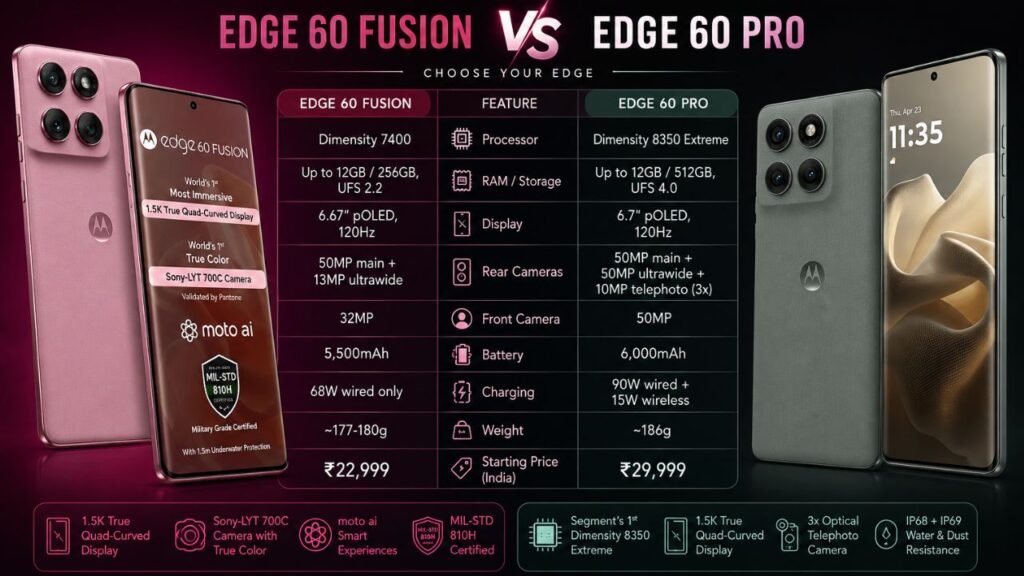
| Feature | Motorola Edge 60 Pro | Motorola Edge 60 Fusion |
| Processor | Dimensity 8350 Extreme | Dimensity 7400 |
| RAM / Storage | Up to 12GB / 512GB, UFS 4.0 | Up to 12GB / 256GB, UFS 2.2 |
| Display | 6.7″ pOLED, 120Hz | 6.67″ pOLED, 120Hz |
| Rear Cameras | 50MP main + 50MP ultrawide + 10MP telephoto (3x) | 50MP main + 13MP ultrawide |
| Front Camera | 50MP | 32MP |
| Battery | 6,000mAh | 5,500mAh |
| Charging | 90W wired + 15W wireless | 68W wired only |
| Weight | ~186g | ~177-180g |
| Starting Price (India) | ₹29,999 | ₹22,999 |
Fact box: The Pro scores higher in power and dots range than the Motorola Edge 60 fusion in the Motorola Edge 60 fusion vs Motorola Edge 60 pro matchup. The Fusion is better in terms of weight and price.
What Sets the Edge 60 Pro Apart?
The Edge 60 Pro is an all-you-can-finger-hard type. It is powered by the Dimensity 8350 Extreme, a 4nm chip with a score of over 4,700 in Geekbench tests of multi-cores, showing its score in 91mobiles benchmark data. This difference makes a difference when you can switch between the applications that consume a lot of power or enjoy graphics-intensive games without performance hiccups.
Capacity increases as well. In the Pro, you can have up to 512GB of UFS 4.0 storage, making it faster than the older standard of UFS 2.2 used in the Fusion to read and write data. This is reflected in daily load times should you shoot a lot of 4K video.
Motorola Edge 60 Pro vs Edge 60 Fusion: Performance Benchmark
| Metric | Edge 60 Pro | Edge 60 Fusion |
| Chipset | Dimensity 8350 Extreme | Dimensity 7400 |
| Geekbench 6 Multi-Core | ~4,289 to 4,759 | ~3,050 |
| RAM Type | LPDDR5X | LPDDR4X |
| Storage Type | UFS 4.0 | UFS 2.2 |
| Gaming Fit | Handles demanding titles smoothly | Fine for casual and mid-tier games |
Fact box: Dimensity 8350 Extreme is approximately 50% faster at multi-core tests than Dimensity 7400.
What Makes the Edge 60 Fusion Worth Considering?
The Edge 60 Fusion satisfies a less complex need. It has almost a similar display, a powerful 50MP primary camera, and a curvy Motorola design at a lower price of about 7000 less than the Pro. The weight of the Fusion is quoted by PhoneArena as about 177.5g, whereas the Pro is 186g, so the hand feel is somewhat different, albeit, slightly.
Its chip 7400 will not pass benchmark challenges, but it does support browsing, streaming and social apps without stuttering. In case your phone consumption is more related to messaging and media than it is to gaming, the Fusion has your back.
Motorola Edge 60 Fusion vs Motorola Edge 60 Pro: How Do the Cameras Compare?
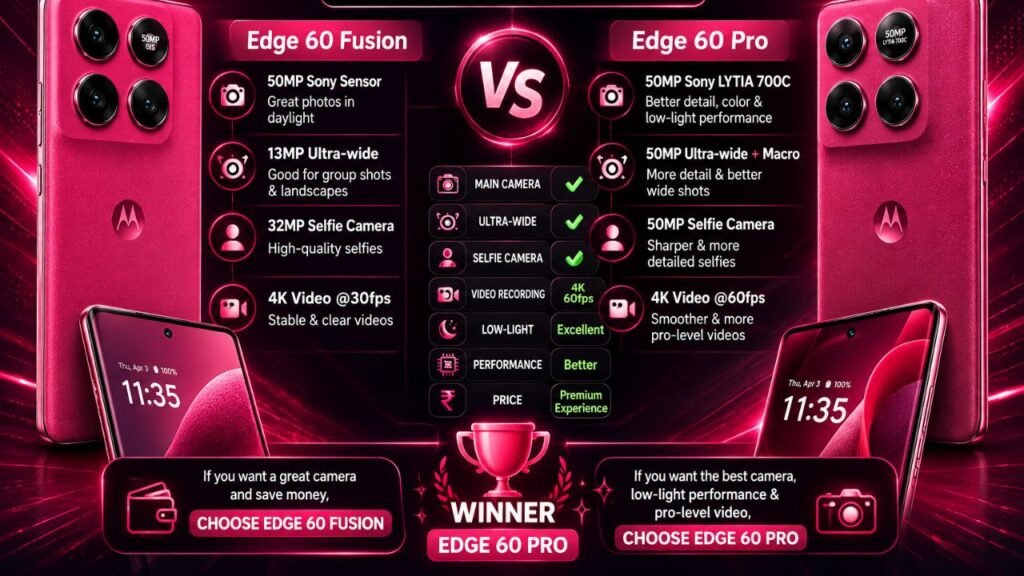
The largest functional difference between the Motorola Edge 60 Fusion and the Motorola Edge 60 Pro lies in the camera module. The two have identical 50MP main sensors with optical image stabilization, hence the wide shots under good light appear to be similar on both gadgets. The contrast is noticed when you pass the primary lens.
The Pro has a 50 MP ultrawide lens and a 10MP telephoto lens with a 3x optical zoom. The real separator is that telephoto lens, as you can bring a subject you want closer without losing sharpness. The Fusion even eliminates telephoto altogether, and its ultrawide reduces to 13MP; this means that broader images are less crisp.
The quality of selfies is no exception. The 50MP front lens of the Pro provides a more optimal focus compared to the Fusion and has a better low-light sensitivity owing to the 32MP sensor.
Camera Specification
| Camera Type | Edge 60 Pro | Edge 60 Fusion |
| Main Sensor | 50MP, OIS | 50MP, OIS |
| Ultrawide | 50MP | 13MP |
| Telephoto | 10MP, 3x optical zoom | Not available |
| Front Camera | 50MP | 32MP |
| Best Use | Zoom shots, detailed wide shots | Daylight, casual social shots |
Fact box: The true optical zoom is not provided on any but the Edge 60 Pro. All the types of shots are totally dependent on the main lens in the Fusion.
Battery Life and Charging Speed: Who Wins?
The Pro has a larger 6,000mAh as compared to Fusion 5,500mAh battery, but not necessarily a longer screen-on time. Surprisingly, battery tests by 91mobiles have revealed the Fusion has a longer continuous use life of almost 11 hours, compared to the only 8.5 hours on the Pro. This is because the lighter chipset of the Fusion will consume less power, in general.
The Pro can be charged quickly, and therein lays the advantage. With a 90W wired charging filling the battery instead of 68W in the Fusion, and the inclusion of 15W of wireless charging, nonspecifically received in the Fusion, it charges the battery much faster and has 15W of wireless charging entirely absent in the Fusion.
Battery and Charging Table
| Metric | Edge 60 Pro | Edge 60 Fusion |
| Battery Capacity | 6,000mAh | 5,500mAh |
| Wired Charging | 90W | 68W |
| Wireless Charging | 15W | Not supported |
| Tested Screen-On Time | ~8h 27m | ~11h 02m |
Fact box: The Fusion is able to last longer than the Pro on day-to-day battery tests, which seemed to be shorter than it, on the basis of a smaller battery.
Motorola Edge 60 Fusion vs Motorola Edge 60 Pro Design and Display: Spot the Differences
Their screens are almost the same day-to-day since both be phones have a 6.7-inch pOLED with 120Hz and Pantone color validations. The Pro has Gorilla Glass 7i and a steelier aluminum frame, with the Fusion having a plastic frame and vegan leather back.
This more solid construction and high-quality finishes such as wood-textured backs make the Pro more cumbersome. To some extent, the Fusion remains lighter and more pocket friendly, a consideration that is important provided that comfort is more important to you than high-quality materials.
Design and Build
| Feature | Edge 60 Pro | Edge 60 Fusion |
| Frame Material | Aluminum | Plastic |
| Back Material | Vegan leather, wood option | Vegan leather |
| Protection | Gorilla Glass 7i, IP68/IP69 | IP68 rated |
| Weight | ~186g | ~177-180g |
Motorola Edge 60 Pro vs Motorola Edge 60 Fusion: Price and Value: Which One Fits Your Budget?
Price usually resolves the Motorola Edge 60 Pro vs Edge 60 fusion dilemma. The Fusion starts around ₹22,999, while the Pro starts near ₹29,999, a gap of roughly ₹7,000. The difference lies in purchasing a quicker processor, a tele-lens, and wireless charging.
The Fusion offers good value in case you are on a tight budget around ₹23,000, and you do not need a zoom camera. You can afford to invest a little more and extend your reach further when you desire a phone that will make you feel that you make something that will stand the test of time, that is the Pro.
Price Comparison
| Configuration | Edge 60 Pro | Edge 60 Fusion |
| Base Price (India) | ₹29,999 | ₹22,999 |
| Higher Config Price | Up to ₹33,999 | Up to ₹27,999 |
| Global Starting Price | ~$432 | ~$231 |
Final Verdict
Comparing the Motorola Edge 60 Pro vs Motorola Edge 60 Fusion, the decision is based on priorities not only on specifications. The Edge 60 Pro is a good option because you do a lot of gaming, prefer zoom photography, or require rapid wired and wireless charging. The Edge 60 Fusion would be a better choice when you want to have a lower-priced, light, good-looking phone capable of doing day-to-day work.
Fast summary: the Pro is a better choice with regards to power, range of camera and charging. The Fusion will be victorious in terms of weight, battery life, and affordability.
Frequently Asked Questions
Yes, when camera zoom and gaming or even wireless charging is important to you. The Pro has a higher chip and a telephoto lens, which provides a more fluid experience to the heavy-users. The difference might not be noticeable by casual users who stream and browse, and thus they may not be willing to pay that amount.
The Fusion has a longer lifespan during real-life testing, although it has a smaller 5,500mAh battery. The 91mobiles test data indicates it is running a little more than 11 hours as compared to about 8.5 hours of the Pro. The smaller chipset is compensated by its light weight.
No, The Fusion does not use telephoto but instead just uses its 50MP primary-side camera plus 13MP ultrawide. The Pro is the only one with the advantage of genuine optical zoom with its 10MP, 3x telephoto lens.
No, the Fusion doesn’t support wireless charging. This feature is only available in the Pro, which also has 90W wired charging.
Yes, the difference is big. Multi-core scores on Geekbench place the 8350 Extreme slightly above of 4,700, versus an estimated 3,040 on the part of the 7400. This translates to quicker switching of apps as well as easier gaming with the Pro.
Read Our Brand Vs Brand Comparison: iPhone vs Samsung: Best Smartphone Comparison Guide

Hi, I’m Aarav Kapoor. I have 5+ years of experience in the technology industry, specializing in smartphones, mobile prices, specifications, comparisons, and buying guides. I recently started this website to help users make informed purchasing decisions by providing accurate pricing, detailed specifications, and the latest updates on smartphone launches from trusted and official sources.