Source: Self-Made
The choice between two Google phones may sound easy, but not as soon as you are in a place and begin comparing the spec sheets. The comparison between the two Google Pixel 10a and 10 Pro is a topic everyone has been keen on this year and, rightly so. Both phones are of the same brand DNA but are positioned at wildly divergent price points and aimed at entirely different consumers. You can choose to save or spend more to buy flagship power, but this guide will help you not guess, at least not when it comes to cash; you have the option.
Google has obviously developed the two gadgets to suit two lifestyles. One mobile phone pursues functionality, photo capability, and high-quality materials. The other is being cost-effective without being low-end. We are about to go through all of the categories, starting with design, then moving to battery, etc., so that at the end of the day, you know which phone would best suit your lifestyle.
Google Pixel 10a vs 10 Pro: Full Specifications
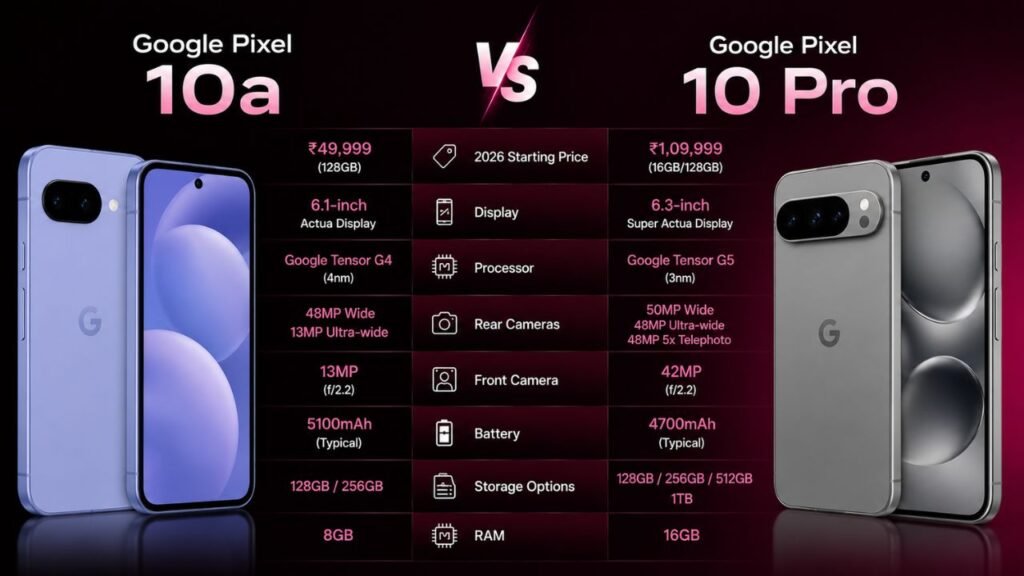
Before diving into details, here is a side-by-side snapshot of everything that matters. This table covers design, display, hardware, camera, battery, and connectivity so you get the full picture in one glance.
| Specification | Google Pixel 10 Pro | Google Pixel 10a |
| Release Date | August 28, 2025 | February 18, 2026 |
| Display Size | 6.3-inch OLED | 6.3-inch P-OLED |
| Resolution | 2856 x 1280 px, 497 PPI | 2424 x 1080 px, 421 PPI |
| Refresh Rate | 120Hz | 120Hz |
| Peak Brightness | 3300 nits | 3000 nits |
| Protection Glass | Corning Gorilla Glass Victus 2 | Corning Gorilla Glass 7i |
| Chipset | Google Tensor G5 (3nm) | Google Tensor G4 (4nm) |
| GPU | PowerVR DXT | Mali-G715 MC7 |
| RAM / Storage | 16GB / 128GB, 256GB, 512GB, 1TB | 8GB / 128GB, 256GB |
| Storage Expansion | Not expandable | Not expandable |
| Battery Capacity | 4870 mAh | 5100 mAh |
| Wired Charging | 30W | 30W |
| Wireless Charging | 15W (Qi2) | 10W (Qi) |
| Rear Camera Setup | Triple camera (50MP + 48MP + 48MP) | Dual camera (48MP + 13MP) |
| Main Camera Aperture | F1.7, 1/1.3-inch sensor | F1.7, 1/2-inch sensor |
| Telephoto Zoom | 5.0x optical | Not available |
| Front Camera | 42MP with PDAF | 13MP fixed focus |
| Video Recording | 4K UHD 60fps, front 4K 60fps | 4K UHD 60fps, front 4K 30fps |
| Body Material | Glass back, Aluminum frame | Plastic back, Aluminum frame |
| Weight | 207 grams | 184 grams |
| Water/Dust Resistance | IP68 | IP68 |
| Fingerprint Sensor | Ultrasonic in-screen | Optical in-screen |
| Bluetooth | 6.0 | 5.3 |
| Wi-Fi | Wi-Fi 7 | Wi-Fi 6E |
| Colors | Moonstone, Obsidian, Jade, Porcelain | Lavender, Berry, Fog, Obsidian |
| Starting Price | ₹1,09,999 (16GB/128GB) | ₹49,999 (128GB) |
Now that you have the full breakdown, let’s unpack what these numbers actually mean for your everyday phone experience.
Design and Build Quality Comparison
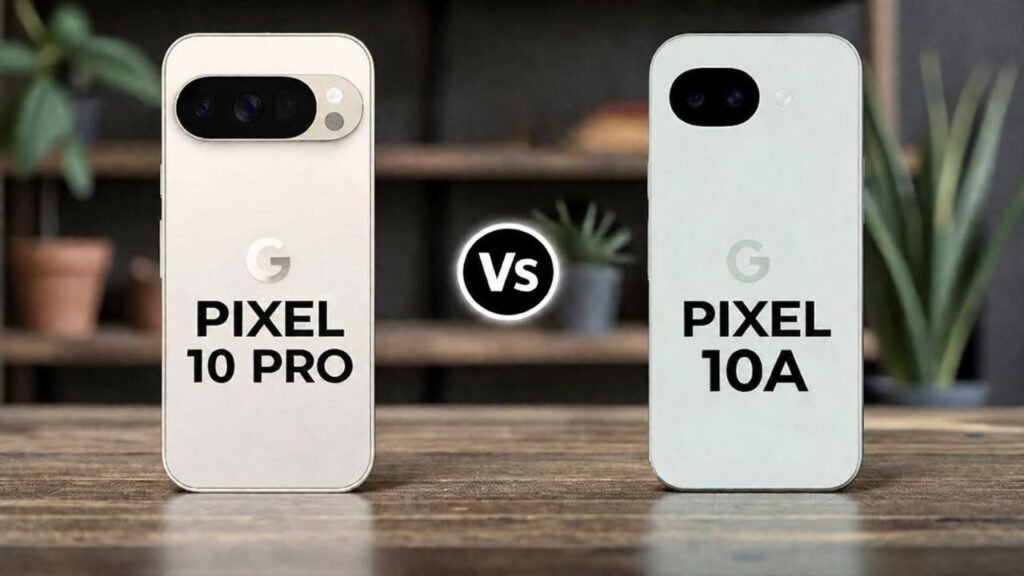
When comparing the Google Pixel 10a vs 10 Pro, design is where the price gap becomes visible instantly. The Pixel 10 Pro uses a glass back with Gorilla Glass Victus 2 protection, paired with an aluminum frame that feels premium in hand. Meanwhile, the Pixel 10a swaps glass for a plastic back, which keeps manufacturing costs lower but still passes IP68 water and dust resistance.
Weight also differs noticeably. The Pro model weighs 207 grams, while the 10a comes in lighter at 184 grams. If you prefer a phone that feels less bulky in your pocket, the 10a wins here. However, if you want that solid, premium glass feel every time you pick up your phone, the Pro edges ahead.
Design Comparison
| Feature | Pixel 10 Pro | Pixel 10a |
| Back Material | Glass (Gorilla Glass Victus 2) | Plastic |
| Frame Material | Aluminum | Aluminum |
| Weight | 207 grams | 184 grams |
| Dimensions | 152.8 x 72 x 8.6 mm | 154.9 x 73.7 x 10.2 mm |
| Water/Dust Rating | IP68 | IP68 |
| Fingerprint Sensor | Ultrasonic in-screen | Optical in-screen |
| Colors Available | Moonstone, Obsidian, Jade, Porcelain | Lavender, Berry, Fog, Obsidian |
Both phones share the Obsidian shade, so if you like classic black, either device satisfies that preference. However, the premium glass finish still gives the Pro a more upscale feel in daily handling.
Display Quality: Pixel 10 Pro vs Pixel 10a Screen
Screen size stays identical at 6.3 inches across both devices, but resolution and brightness separate them clearly. The Pixel 10 Pro packs a sharper 2856 x 1280 resolution at 497 PPI, while the 10a offers 2424 x 1080 at 421 PPI. Although both numbers sound high, the Pro delivers noticeably crisper text and images, especially useful for reading or watching high-resolution content.
Brightness is another factor worth noting. The Pro reaches up to 3300 nits, whereas the 10a tops out at 3000 nits. Both screens run at a 120Hz refresh rate, so scrolling feels equally smooth on either device.
Display Comparison
| Feature | Pixel 10 Pro | Pixel 10a |
| Screen Size | 6.3-inch OLED | 6.3-inch P-OLED |
| Resolution | 2856 x 1280 px | 2424 x 1080 px |
| Pixel Density | 497 PPI | 421 PPI |
| Refresh Rate | 120Hz | 120Hz |
| Peak Brightness | 3300 nits | 3000 nits |
| Screen-to-Body Ratio | 86.95% | 79.39% |
| Protection Glass | Gorilla Glass Victus 2 | Gorilla Glass 7i |
Screen-to-body ratio also favors the Pro, giving it slimmer bezels and a more immersive viewing experience overall.
Performance and Chipset Breakdown
Performance is arguably the biggest differentiator in the Google Pixel 10a vs 10 Pro conversation. The Pro runs on Google’s newest Tensor G5 chip, built using a 3nm process. This chip pairs with a PowerVR DXT graphics unit, promising faster processing and improved efficiency.
The Pixel 10a, meanwhile, sticks with the older Tensor G4 chipset manufactured on a 4nm process, alongside a Mali-G715 MC7 GPU. While this chip still handles everyday tasks smoothly, it clearly falls behind the Pro in raw computing power and graphics rendering.
Performance Comparison
| Feature | Pixel 10 Pro | Pixel 10a |
| Chipset | Tensor G5 (3nm) | Tensor G4 (4nm) |
| GPU | PowerVR DXT | Mali-G715 MC7 |
| RAM Options | 16GB | 8GB |
| Storage Options | 128GB, 256GB, 512GB, 1TB | 128GB, 256GB |
| Storage Expansion | Not expandable | Not expandable |
| Geekbench 6 Single-Core | 2314 | Untested |
| Geekbench 6 Multi-Core | 6274 | Untested |
| 3D Mark High | 3426 | Untested |
| 3D Mark Low | 2118 | Untested |
Memory capacity shows an even bigger gap between the two phones. The Pro scales all the way up to 1TB storage for power users, while the 10a caps out at 256GB, which should still be enough for casual users.
Camera Comparison: Which Pixel Takes Better Photos?
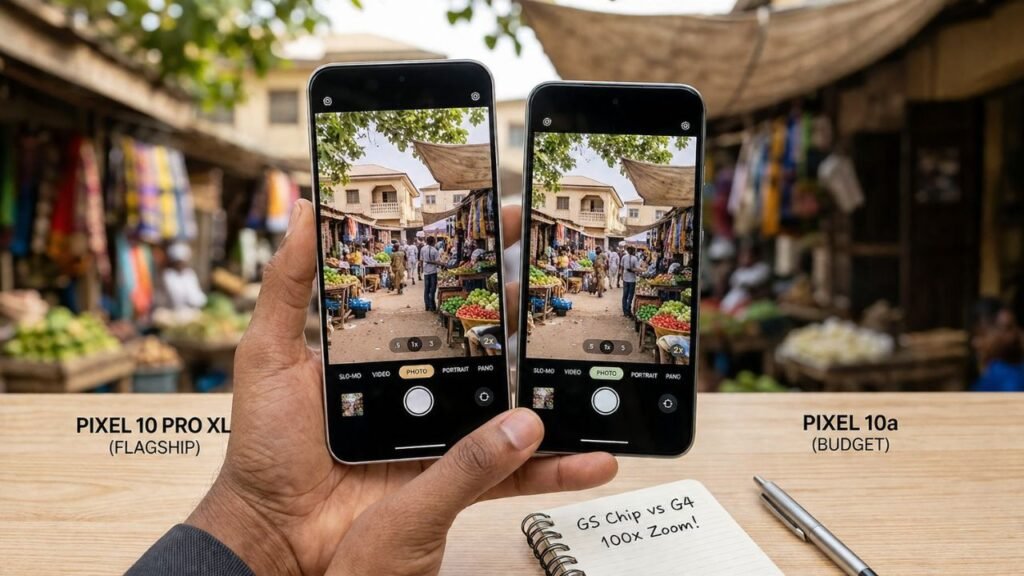
Camera performance is where flagship pricing really justifies itself. The Pixel 10 Pro features a triple camera setup, including a 50MP main sensor with OIS and PDAF, an F1.7 aperture, and a large 1/1.3-inch sensor size. It also adds a 48MP ultrawide lens and a 48MP telephoto lens offering 5.0x optical zoom, something completely missing on the 10a.
In contrast, the Pixel 10a sticks with a simpler dual camera system. Its main sensor is 48MP with OIS and PDAF, though the sensor size shrinks to 1/2-inch. Without a telephoto lens, zoom photography becomes significantly weaker on this model.
Camera Comparison
| Feature | Pixel 10 Pro | Pixel 10a |
| Rear Setup | Triple camera | Dual camera |
| Main Sensor | 50MP, F1.7, 1/1.3-inch | 48MP, F1.7, 1/2-inch |
| Ultrawide Sensor | 48MP, F1.7 | 13MP, F2.2 |
| Telephoto Lens | 48MP, 5.0x optical zoom | Not available |
| Front Camera | 42MP with PDAF | 13MP, fixed focus |
| Front Video Recording | 4K UHD 60fps | 4K UHD 30fps |
| Flash Type | LED | Dual LED |
| Camera Test Score (Overall) | 151 | Untested |
| Camera Test Score (Photo) | 162 | Untested |
| Camera Test Score (Video) | 140 | Untested |
Since the Pixel 10a has not undergone formal testing yet, direct score comparisons remain unavailable for now. Still, the missing telephoto lens and smaller sensor suggest a clear gap in zoom and low-light photography.
Battery Life and Charging Speed
Interestingly, battery capacity favors the budget model here. The Pixel 10a carries a 5100 mAh battery, larger than the Pro’s 4870 mAh cell. This happens partly because the 10a doesn’t need to power a more demanding chipset or extra camera hardware, allowing better raw endurance on paper.
Both phones support 30W wired fast charging, so charging speed remains equal in that department. Wireless charging tells a different story, though.
Battery Comparison
| Feature | Pixel 10 Pro | Pixel 10a |
| Battery Capacity | 4870 mAh | 5100 mAh |
| Wired Charging Speed | 30W | 30W |
| Wireless Charging Speed | 15W (Qi2) | 10W (Qi) |
| Battery Life Estimate | 7h 17min | Untested |
| Browsing Time | 20h 55min | Untested |
| Video Playback Time | 10h 18min | Untested |
| Gaming Time | 4h 36min | Untested |
Based on actual testing, the Pixel 10 Pro delivered strong all-around endurance despite its smaller battery, largely thanks to chipset efficiency. The Pixel 10a currently remains untested across these categories, though its bigger cell suggests solid standby performance.
Connectivity and Extra Features
Connectivity options also separate these two devices. The Pixel 10 Pro supports Bluetooth 6.0 and Wi-Fi 7, giving it an edge in speed and future-proofing. Meanwhile, the Pixel 10a uses Bluetooth 5.3 and Wi-Fi 6E, both still reliable but slightly behind current standards.
Biometric security differs too. The Pro uses an ultrasonic in-display fingerprint sensor, generally faster and more accurate. The 10a relies on an optical in-display sensor instead, which works well but isn’t quite as fast in low-light conditions.
Connectivity Comparison
| Feature | Pixel 10 Pro | Pixel 10a |
| Bluetooth Version | 6.0 | 5.3 |
| Wi-Fi Standard | Wi-Fi 7 | Wi-Fi 6E |
| USB Type | Type-C, USB 3.2 | Type-C, USB 3.2 |
| SIM Type | Nano SIM, eSIM | Nano SIM, eSIM |
| Satellite SOS | Yes | No |
| NFC Support | Yes | Yes |
| Fingerprint Type | Ultrasonic | Optical |
Another standout Pro feature is Emergency SOS via satellite, letting users send SMS messages without cellular signal. This feature is currently absent on the Pixel 10a. Both phones include standard sensors like accelerometer, gyroscope, compass, and barometer.
Pricing: Is the Pixel 10 Pro Worth the Extra Cost?
Pricing ultimately drives most buying decisions. The Pixel 10 Pro starts at $999 for the 16GB/128GB variant, climbing up to $1449 for the massive 1TB storage option. On the flip side, the Pixel 10a costs just $499 for its single 128GB configuration, making it half the price of its flagship sibling.
Pricing Comparison
| Storage Variant | Pixel 10 Pro Price | Pixel 10a Price |
| 128GB | $999 | $499 |
| 256GB | $1099 | Not available |
| 512GB | $1219 | Not available |
| 1TB | $1449 | Not available |
Consequently, budget-conscious buyers gain access to Google’s ecosystem without breaking the bank, while those wanting flagship-level cameras, performance, and premium materials will find the Pro’s pricing justified.
Google Pixel 10a vs 10 Pro: Final Comparison Summary
So, how should you decide between these two phones? If camera quality, processing power, and premium build matter most to you, the Pixel 10 Pro clearly stands out as the stronger choice. However, if you want solid performance, a bigger battery, and significant savings, the Pixel 10a delivers excellent value for half the price.
Ultimately, this Google Pixel 10a vs 10 Pro comparison shows that Google successfully created two phones serving very different needs. Your final decision should depend on budget, camera priorities, and how much future-proofing matters to you.
Frequently Asked Questions
The Pixel 10 Pro wins easily thanks to its triple camera setup, larger sensor size, and added telephoto lens with 5x optical zoom. The Pixel 10a’s dual camera system works fine for casual photography but lacks zoom capability and lower light performance.
Yes, the Pixel 10a supports 10W Qi wireless charging, though it’s slower compared to the Pro’s 15W Qi2 wireless charging speed.
Yes, the Tensor G5 chip found in the Pixel 10 Pro uses a newer 3nm manufacturing process and outperforms the Tensor G4 in both benchmark testing and real-world speed.
Surprisingly, the Pixel 10a has a slightly bigger battery at 5100 mAh, compared to the Pro’s 4870 mAh, though performance efficiency also plays a role in actual battery life.
No, the Pixel 10a only includes a main and ultrawide lens. Optical zoom photography is exclusive to the Pixel 10 Pro’s triple camera system.
The Pixel 10 Pro comes with 16GB RAM across all storage variants, while the Pixel 10a offers 8GB RAM regardless of storage choice.

Hi, I’m Aarav Kapoor. I have 5+ years of experience in the technology industry, specializing in smartphones, mobile prices, specifications, comparisons, and buying guides. I recently started this website to help users make informed purchasing decisions by providing accurate pricing, detailed specifications, and the latest updates on smartphone launches from trusted and official sources.