Updated September 10, 2026
Cupertino, September 9, 2026 – Apple used its “Surprise and Shine” event to unveil the phone rumors had been building toward for years: its first foldable smartphone, the iPhone Duo. It was announced on the same stage as the iPhone 18 Pro and iPhone 18 Pro Max, marking Apple’s first genuinely new form factor since the iPhone X in 2017. John Ternus ran the keynote – his first as CEO after taking over from Tim Cook – and the biggest reveal of the night wasn’t a chip or a camera. It was a hinge.
For two years, every leak pointed to “iPhone Ultra” or, if the leakers were feeling unimaginative, “iPhone Fold.” Apple went with neither. It’s a small choice, but a telling one: the company clearly didn’t want its foldable measured against Samsung’s “Fold” branding by name alone – even though that’s exactly the comparison it’s about to spend the next two years fending off.
iPhone Duo Full Specification
| Category | Specification |
|---|---|
| Launch | Announced September 9, 2026 · Available October 23, 2026 |
| Design | Book-style foldable · Grade 5 titanium frame · Night Sky, Star White |
| Outer Display | 5.4-inch Super Retina XDR · ProMotion · Always-On · Dynamic Island |
| Inner Display | 7.6-inch Super Retina XDR (foldable) · Nano-texture finish · ProMotion · Always-On |
| Peak Brightness | Up to 3,000 nits |
| Chip | Apple A20 Pro (6-core CPU, 7-core GPU, dual 16-core Neural Engine) |
| Cooling | Custom vapor chamber thermal system |
| Rear Camera | 48MP Main (12MP 2x optical-quality zoom) + 48MP Ultra Wide |
| Front Camera | 12MP Center Stage, under-display (inner screen) |
| Video Recording | Up to 4K Dolby Vision at 120fps |
| Camera Software | Duo Preview, Smart Take, Kid Cue, Duo FaceTime |
| Battery (Outer) | Up to 44 hours video playback |
| Battery (Inner) | Up to 31 hours video playback |
| Charging | ~50% in 20 minutes with 60W+ adapter (sold separately) · MagSafe supported |
| Biometrics | Touch ID (no Face ID) |
| SIM | eSIM only, no physical SIM tray |
| Modem | Apple C2 |
| Data Transfer | USB 3, up to 10Gb/s |
| Operating System | iOS 27.1 |
| Storage Options | 256GB, 512GB, 1TB, 2TB |
| Stylus Support | USB-C Apple Pencil (coming later in 2026, not at launch) |
| Price (US) | $1,999 (256GB) to $3,199 (2TB) |
| Price (India) | ₹2,99,900 (256GB) to ₹4,49,900 (2TB) |
| Colors | Night Sky, Star White |
| Countries at Launch | 70+ including US, UK, Canada, Australia, China, France, Germany, India, Japan |
iPhone Duo Price and Storage Options
The iPhone Duo comes in four storage tiers:
| Storage | US Price | India Price (approx.) |
| 256GB | $1,999 | ₹2,99,900 |
| 512GB | Not yet disclosed | Not yet disclosed |
| 1TB | Not yet disclosed | Not yet disclosed |
| 2TB | $3,199 | ₹4,49,900 |
iPhone Duo Design: A Titanium Body With Two Screens
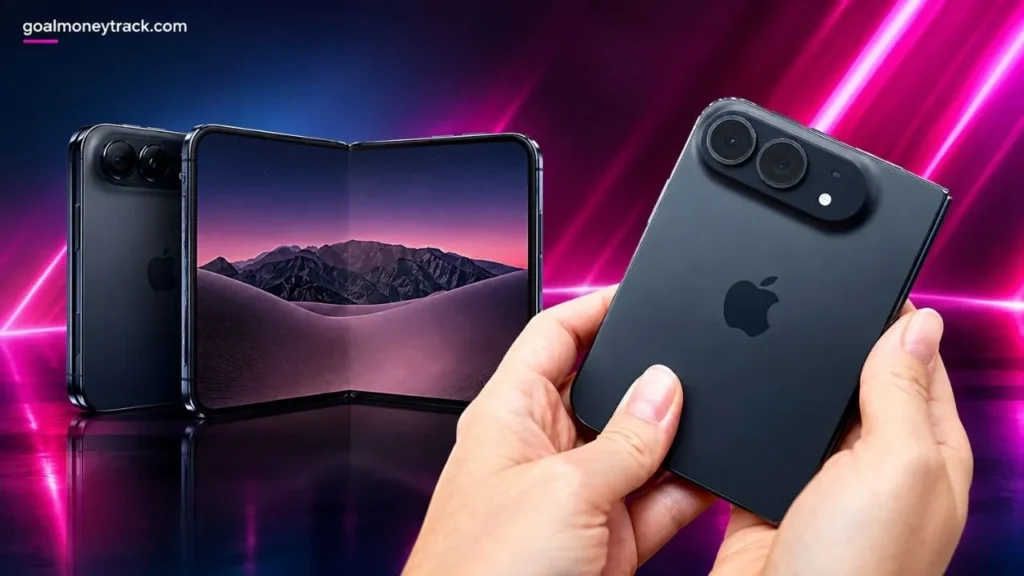
The iPhone Duo follows a book-style folding design. Its structure is built from grade 5 titanium, giving it a premium, durable feel. The phone comes in two finishes: Night Sky and Star White.
The standout design detail is that, unfolded, this is Apple’s thinnest iPhone ever made. It’s held together by a precision-engineered hinge that Apple says delivers a smooth, satisfying feel and is built to hold up over long-term use.
One casualty of the new shape: Face ID is gone. The Duo uses Touch ID instead, most likely because there simply wasn’t a sensible place to put a Face ID array in a folding chassis – the kind of trade-off longtime iPhone owners will notice within the first ten minutes of using the phone.
Two Displays, One Continuous Experience
The iPhone Duo has two separate screens:
- Outer Display: A 5.4-inch Super Retina XDR display that keeps the phone compact and pocketable when closed. It covers about 90 percent of the screen area of the iPhone 18 Pro – this is the screen you’ll actually look at most of the day.
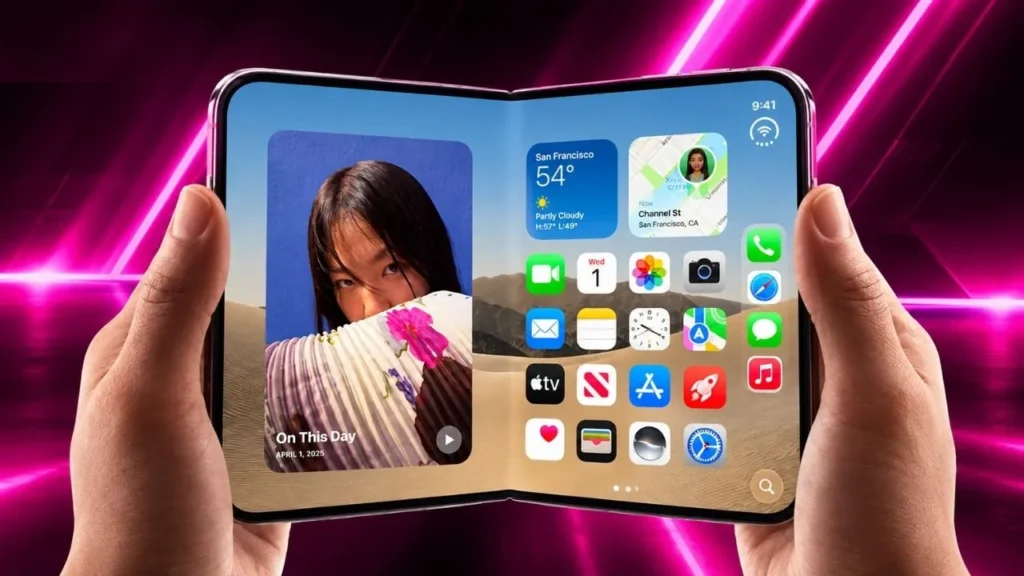
- Inner Folding Display: A 7.6-inch Super Retina XDR display, the largest screen ever fitted to an iPhone. It has a special nano-texture finish that cuts down glare, useful since a phone you’re constantly opening flat tends to catch light from every angle.
Both screens share the same aspect ratio, so content scales proportionally as it moves between the outer and inner displays. Both also support ProMotion and Always-On, and the Dynamic Island carries over as well.
Chip and Performance
Powering the device is Apple’s new A20 Pro chip, built around a 6-core CPU, 7-core GPU, and a dual 16-core Neural Engine, giving it strong headroom for AI tasks, gaming, and multitasking.
Keeping that chip cool inside a folding body that’s supposed to also be Apple’s thinnest ever is a genuine engineering problem. Apple’s answer is a custom vapor chamber, borrowing a cooling trick from its own M-series Mac chips rather than anything used in prior iPhones.
Camera System
On the back, the iPhone Duo uses a 48MP Dual Fusion camera system:
- 48MP Main camera
- 48MP Ultra Wide camera
- A 12MP optical-quality 2x zoom is built into the Main camera itself (there’s no separate telephoto lens)
Up front is a 12MP Center Stage camera, placed under the display for FaceTime calls on the inner screen.
For video, the phone can shoot Dolby Vision at up to 4K 120fps, with smart focus tracking and improved low-light performance.
Where it gets genuinely new is the software built around having two screens. Duo Preview shows subjects a live camera preview on the outer screen, so the person being photographed can see themselves before the shot is taken. Smart Take fires automatically once everyone in frame is posed and ready – useful for the person always stuck taking the group photo instead of being in it. Kid Cue and Duo FaceTime lean into hands-free, fold-aware calling.
Battery Life
Because the phone effectively runs two screens, Apple gives two battery figures instead of one:
- Outer display video playback: up to 44 hours
- Inner display video playback: up to 31 hours
With a 60W or higher wired charger (sold separately), Apple claims roughly 50 percent charge in about 20 minutes.
Connectivity and Other Features
- C2 modem chip for cellular connectivity
- No physical SIM tray – eSIM only
- USB 3 transfer speeds of up to 10Gb/s
- MagSafe support
- Touch ID instead of Face ID, a change tied to the folding design
- Ships with iOS 27.1, which brings fold-specific features like Split View multitasking, hands-free FaceTime, and StandBy mode
- USB-C Apple Pencil support is planned for later in 2026, though it wasn’t ready at launch
Release Timeline
Unlike the iPhone 18 Pro models, the iPhone Duo won’t hit shelves in September. Its rollout is staggered:
- Pre-orders open: Friday, October 16, 2026, at 5:00 a.m. Pacific Time (US) / 1:00 p.m. in the UK
- On sale: Friday, October 23, 2026, in more than 70 countries and regions, including the US, UK, Canada, Australia, China, France, Germany, India, and Japan
- A further 28 countries and regions get it on October 30, 2026
iPhone 18 Pro and Pro Max: The Quick Version
At the same event, Apple also announced the iPhone 18 Pro lineup, which arrives much sooner:
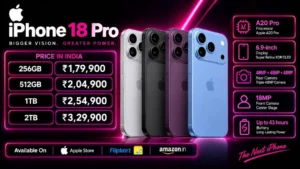
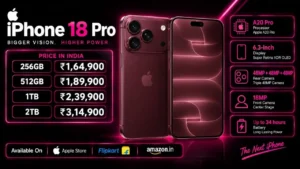
- iPhone 18 Pro: starts at $1,199 (256GB)
- iPhone 18 Pro Max: starts at $1,299 (256GB), with the top-end 2TB configuration reaching $2,499
- Both share the A20 Pro chip
- Pre-orders begin September 12, with shipping starting September 18
How It Stacks Up Against the Galaxy Z Fold 8
Samsung got here first, and by a wide enough margin that comparisons were inevitable the moment Apple confirmed a fold. The Galaxy Z Fold 8, released back in July, switched to the same short-and-wide “passport” shape Apple just adopted, so for the first time an Apple and Samsung flagship actually look like siblings rather than distant cousins.
A few numbers worth knowing before picking a side:
- Price: Z Fold 8 starts $100 lower, at $1,899 for 256GB, and tops out at $2,499 for 1TB – meaning Apple’s most expensive 2TB configuration costs roughly $700 more, albeit for double the storage.
- Thickness and weight: The Z Fold 8 is thinner (8.9mm folded vs. the Duo’s 11.3mm) and lighter (215g vs. roughly 254g).
- Displays: Both land on a 7.6-inch inner panel and a peak brightness around 3,000 nits. Samsung’s outer screen is a hair bigger, 5.5 inches to Apple’s 5.4 – close enough that it’s unlikely to be anyone’s deciding factor.
- A quiet irony: Samsung’s display division is widely reported to manufacture the foldable OLED panel inside the iPhone Duo, which means Apple’s most direct rival is also one of its suppliers here.
If raw thinness and weight matter most, Samsung still has the edge. If you’re already inside Apple’s ecosystem, that’s unlikely to change the decision either way – this was never really a phone aimed at Android switchers.
Our Take
The iPhone Duo isn’t a moonshot. It’s Apple doing what Apple usually does: arriving late to a category, matching the leader’s hardware almost spec-for-spec, and betting that software polish and ecosystem lock-in close the gap. On paper, it does that. Whether the hinge holds up after a year of daily folding, and whether losing Face ID actually bothers people day to day, are things only real-world use will answer – not a keynote.
Read Latest News: Samsung Galaxy S26 FE Price | Motorola Edge 70 Neo
FAQs
It’s Apple’s first foldable iPhone – a book-style folding phone with a compact outer display and a large inner display, announced on September 9, 2026.
It starts at $1,999 for the 256GB model in the US (around ₹2,99,900 in India), going up to $3,199 for the 2TB model (around ₹4,49,900 in India).
Pre-orders open October 16, 2026, and the phone goes on sale October 23, 2026, in over 70 countries, including India. A second wave of 28 more countries gets it on October 30.
Apple hasn’t given an official reason, but the more complex folding hardware – hinge, dual display, dual battery – likely needs a longer production runway than the standard Pro models.
The A20 Pro, the same chip found in the iPhone 18 Pro and Pro Max, paired with a custom vapor chamber for cooling.
No. Because of the folding design, Apple switched to Touch ID on the iPhone Duo instead of Face ID.
No, it’s eSIM-only – there’s no physical SIM tray.
A 48MP Main and 48MP Ultra Wide rear camera system (with a built-in 12MP 2x optical-quality zoom), plus a 12MP under-display front camera for FaceTime. Video tops out at 4K Dolby Vision at 120fps.
Apple rates it at up to 44 hours of video playback using the outer display and up to 31 hours using the inner display, thanks to a dual-battery setup.
Night Sky and Star White.
Yes, MagSafe charging and accessories are supported.
Apple has said USB-C Apple Pencil support is coming later in 2026, though it wasn’t available at launch.
The Z Fold 8 is cheaper, starting at $1,899 versus $1,999 for the Duo, and is both thinner and lighter, while both phones share a similar 7.6-inch inner display and peak brightness.

Hi, I’m Aarav Kapoor. I have 5+ years of experience in the technology industry, specializing in smartphones, mobile prices, specifications, comparisons, and buying guides. I recently started this website to help users make informed purchasing decisions by providing accurate pricing, detailed specifications, and the latest updates on smartphone launches from trusted and official sources.