Last Updated: 1 September 2026
If you are looking for the best gaming phone under 60000, you no longer have to compromise on flagship-level performance. Phones in this price range now offer powerful chipsets such as the Snapdragon 8 Gen 5 and MediaTek Dimensity 9500s, fast AMOLED displays, large silicon-carbon batteries, high-speed storage, and increasingly sophisticated cooling systems.
But buying a gaming phone is not simply about choosing the phone with the highest AnTuTu score.
A phone that delivers an excellent benchmark score for five minutes can still be a poor gaming phone if it throttles during a long BGMI match, gets uncomfortable to hold, drains its battery quickly or lacks useful gaming features. For this list, we therefore look beyond specifications and consider sustained performance, thermal behaviour, display and touch response, battery endurance, charging, gaming software and value for money.
Based on the current September 2026 market, these are the best options to consider.
Best gaming phones under ₹60,000 at a glance
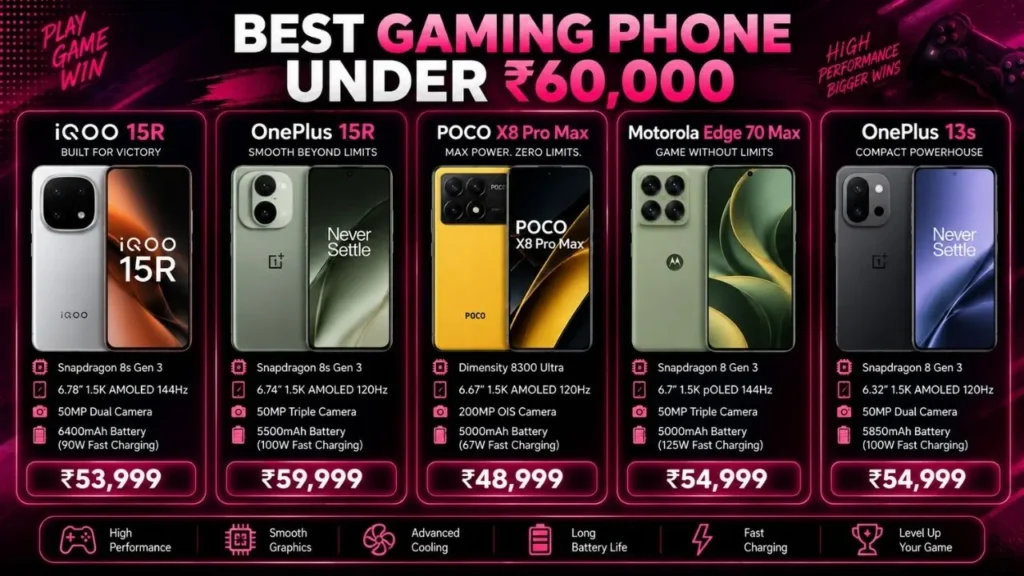
| Phone | Approx. price | Processor | Display | Battery | Best for |
| iQOO 15R | ₹53,999 | Snapdragon 8 Gen 5 | 1.5K 144Hz AMOLED | 7,600mAh | Best overall gaming |
| OnePlus 15R | ₹59,999 | Snapdragon 8 Gen 5 | 1.5K 165Hz AMOLED | 7,400mAh | Competitive FPS gaming |
| POCO X8 Pro Max | ₹48,999 | Dimensity 9500s | 1.5K 120Hz AMOLED | 9,000mAh | Best value & battery |
| Motorola Edge 70 Max | ₹54,999* | Snapdragon 8 Gen 5 | QHD+ 144Hz AMOLED | 7,100mAh | Best display + gaming |
| OnePlus 13s | ₹54,999 | Snapdragon 8 Elite | FHD+ 120Hz LTPO AMOLED | 5,850mAh | Compact gaming phone |
*Prices fluctuate by retailer, offers, and variant.
1. iQOO 15R – Best gaming phone under ₹60,000 overall
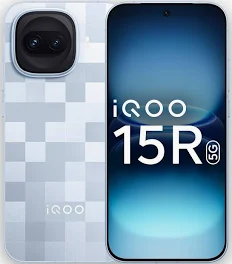
If gaming is the primary reason you are buying the phone, the iQOO 15R is the strongest all-round package in this price range.
The phone combines Qualcomm’s Snapdragon 8 Gen 5 with a dedicated Q2 Supercomputing Chip, a 1.5K 144Hz AMOLED display, a 7,600mAh battery, 100W charging and a 6.5K IceCore VC cooling system. iQOO also specifies a 360Hz gaming touch sampling rate.
The most important point is that its gaming hardware is not limited to the processor. The cooling system, high touch response and dedicated gaming silicon are designed to maintain performance under sustained workloads rather than simply producing impressive benchmark numbers.
Key specifications
- Processor: Snapdragon 8 Gen 5
- RAM: 8GB/12GB
- Storage: 256GB/512GB
- Display: 6.59-inch 1.5K AMOLED, 144Hz
- Gaming touch sampling: up to 360Hz
- Battery: 7,600mAh
- Charging: 100W
- Cooling: 6.5K IceCore VC
- Software: OriginOS 6
- Connectivity: Wi-Fi 7
The base 8GB + 256GB model is currently listed by iQOO at ₹53,999, although pricing can change.
Why it is excellent for gaming
The 6.59-inch screen is smaller than some of its rivals, but that can actually help with gaming ergonomics. It is easier to grip and manipulate during long sessions than a very large 6.8-inch handset.
The 360Hz gaming touch sampling is also more relevant to competitive players than simply advertising a high display refresh rate. A 144Hz panel determines how frequently the display can refresh; touch sampling determines how frequently the phone can detect touch input.
The iQOO 15R also has a huge 7,600mAh battery, making it particularly well suited to long gaming sessions.
The catch
The iQOO 15R is not the best choice if camera quality is your priority. Its camera system is much more performance-oriented than camera-centric rivals, with a 50MP main camera and 8MP ultrawide.
It is also worth paying attention to the exact variant and current selling price because the higher-storage versions can move beyond the ₹60,000 budget.
Who should buy it?
Buy the iQOO 15R if you want the strongest gaming-first package under ₹60,000 and spend more time playing than taking photographs.
2. OnePlus 15R – Best for competitive FPS gaming
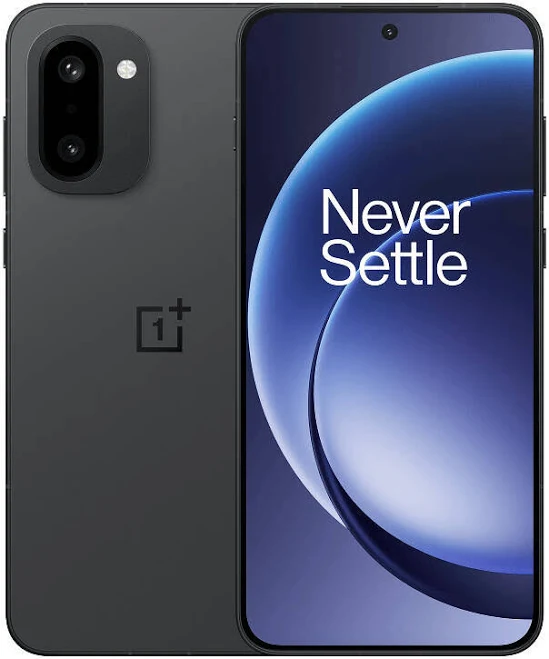
The OnePlus 15R is arguably the most convincing alternative to the iQOO 15R, particularly if your gaming revolves around competitive titles.
It uses the Snapdragon 8 Gen 5 and pairs it with 12GB LPDDR5X Ultra RAM, UFS 4.1 storage, a 6.83-inch 1.5K AMOLED panel and a maximum 165Hz refresh rate. OnePlus also gives it a 7,400mAh battery and 80W SUPERVOOC charging.
More importantly, independent testing gives the OnePlus 15R a strong gaming case. 91mobiles currently ranks it first in its ₹40,000–₹60,000 gaming category after testing BGMI and Call of Duty: Mobile under demanding settings. The publication specifically highlights its frame-rate consistency and heat management.
Key specifications
- Processor: Snapdragon 8 Gen 5
- RAM: 12GB/16GB
- Storage: 256GB/512GB
- Display: 6.83-inch 1.5K AMOLED
- Refresh rate: up to 165Hz
- Battery: 7,400mAh
- Charging: 80W
- Storage: UFS 4.1
- Wi-Fi: Wi-Fi 7
- Haptics: X-axis linear motor
The current India price is around ₹59,999 for the 12GB + 256GB variant.
Why choose it over the iQOO 15R?
The biggest advantage is the display.
The 165Hz panel provides a higher refresh-rate ceiling, although this should not be interpreted as every game running at 165fps. OnePlus explicitly notes that 144Hz/165Hz modes are supported only in listed apps.
For competitive gamers, the combination of Snapdragon 8 Gen 5, high touch responsiveness, a large display and strong sustained performance makes it particularly attractive.
The catch
At ₹59,999, the OnePlus 15R leaves almost no room under the ₹60,000 ceiling.
It also prioritises performance over camera versatility. If you want the best gaming hardware per rupee rather than the OnePlus ecosystem, the POCO X8 Pro Max offers an interesting alternative at considerably less money.
Who should buy it?
Choose the OnePlus 15R if you play competitive FPS games and want a large, high-refresh display with flagship-class processing.
3. POCO X8 Pro Max – Best value gaming phone under ₹60,000
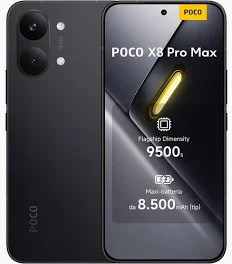
The POCO X8 Pro Max is the phone that makes the ₹60,000 budget look excessive if your only concern is gaming.
It combines a MediaTek Dimensity 9500s processor with 12GB LPDDR5X RAM, UFS 4.1 storage, a 9,000mAh battery and 100W HyperCharge. The 6.83-inch AMOLED display has a 1.5K resolution and 120Hz refresh rate.
Its current Indian starting price is around ₹48,999 following recent price revisions.
Why gamers should take it seriously
The X8 Pro Max is not simply a specification-sheet winner.
91mobiles’ testing recorded a Wild Life Extreme score of 6,194, higher than the iQOO 15R in the same comparison. It also recorded only 4 percent battery drain in the cited 30-minute gaming test.
That makes it particularly interesting for gamers who care about sustained play rather than peak benchmark performance.
The 9,000mAh battery is another major advantage. Large batteries are especially useful for gaming because demanding 3D workloads can consume considerably more power than normal social media or video use.
Key specifications
- Processor: MediaTek Dimensity 9500s
- RAM: 12GB LPDDR5X
- Storage: 256GB/512GB UFS 4.1
- Display: 6.83-inch 1.5K AMOLED
- Refresh rate: 120Hz
- Touch sampling: up to 480Hz
- Game Turbo instant touch sampling: up to 2,560Hz
- Battery: 9,000mAh
- Charging: 100W
- Water resistance: IP68
POCO specifies up to 480Hz touch sampling and a much higher instant touch sampling mode under Game Turbo. These figures should not be confused with the actual display refresh rate.
The catch
This is a large, heavy phone at around 218g, and its software experience is less polished than what you get from OnePlus.
The cameras are also not the reason to buy this phone.
Who should buy it?
Buy the POCO X8 Pro Max if you want maximum gaming performance, battery endurance and storage for the least money.
For pure value, it is arguably the most compelling phone on this list.
4. Motorola Edge 70 Max – Best display for gaming
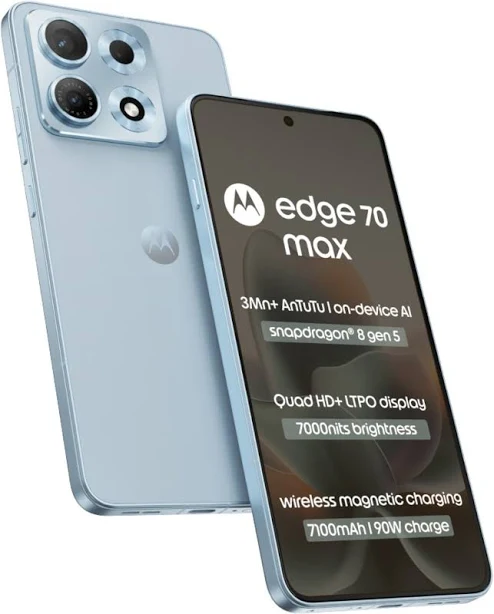
The Motorola Edge 70 Max is an unusual gaming recommendation because Motorola is not traditionally associated with gaming phones.
That changes with this model.
The Edge 70 Max uses the Snapdragon 8 Gen 5 and combines it with a 6.8-inch QHD+ AMOLED display, 144Hz refresh rate, 7,100mAh silicon-carbon battery and 90W charging. It also has a 5,500mm² vapour chamber cooling system and supports bypass charging.
Its biggest advantage: the screen
Most gaming phones around ₹50,000–₹60,000 use a 1.5K display.
The Edge 70 Max goes further with a 2K/QHD+ panel.
That makes games, videos and everyday content look exceptionally sharp. The display also supports up to 144Hz and up to 360Hz touch sampling.
However, there is an important caveat: 91mobiles found that the display was limited to 120Hz during its testing despite the 144Hz specification.
That is precisely why a gaming-phone ranking should not blindly equate advertised specifications with real-world performance.
Key specifications
- Processor: Snapdragon 8 Gen 5
- RAM: 8GB/12GB LPDDR5X
- Storage: 256GB UFS 4.1
- Display: 6.8-inch QHD+ AMOLED
- Refresh rate: up to 144Hz
- Touch sampling: up to 360Hz
- Battery: 7,100mAh
- Charging: 90W
- Wireless charging: 25W magnetic
- Cooling: 5,500mm² vapour chamber
- Durability: IP68/IP69 + MIL-STD-810H
Its current market price is around ₹52,000–₹55,000 depending on retailer and variant.
The catch
The QHD+ panel is beautiful, but higher resolution can increase the rendering workload in demanding games.
So, if you are an esports player chasing maximum frame-rate consistency, a 1.5K display paired with aggressive gaming optimisation can make more sense than a 2K panel.
Who should buy it?
Choose the Edge 70 Max if you want gaming performance without giving up a premium QHD+ display, strong build quality and wireless charging.
5. OnePlus 13s – Best compact gaming phone
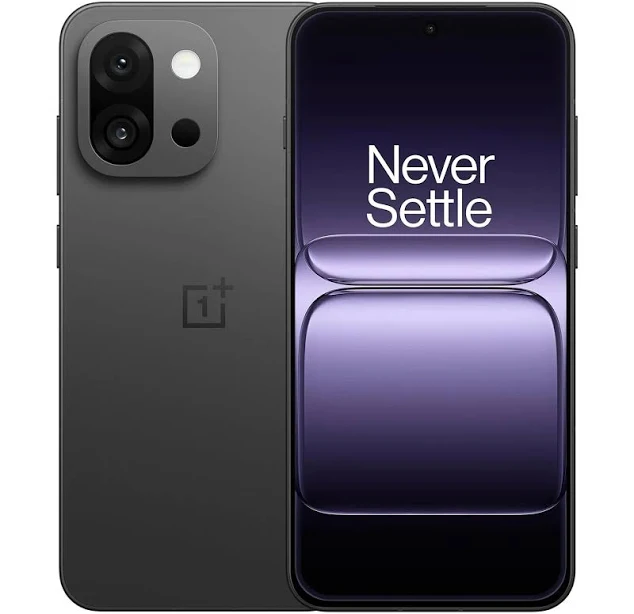
The OnePlus 13s is different from most phones in this list because it does not try to win the gaming battle with an enormous battery or oversized chassis.
Instead, it offers a relatively compact 6.32-inch form factor, Snapdragon 8 Elite performance and an LTPO AMOLED display.
The official specifications list a Snapdragon 8 Elite, 12GB LPDDR5X RAM, UFS 4.0 storage, a 5,850mAh battery and 80W charging. The display supports a dynamic 1–120Hz refresh rate.
Why it makes sense for gamers
A compact phone can be easier to control during long sessions.
The 185g weight is considerably lower than phones such as the POCO X8 Pro Max and OnePlus 15R.
That matters if you play for several hours and find larger gaming phones uncomfortable.
The Snapdragon 8 Elite is also still a powerful flagship-class platform, so the OnePlus 13s is not a low-performance compromise.
The catch
The 120Hz ceiling is lower than the 144Hz and 165Hz panels offered by the top gaming-focused competitors.
The 5,850mAh battery is also significantly smaller than the 7,400mAh–9,000mAh batteries found elsewhere in this list.
Who should buy it?
Pick the OnePlus 13s if you want flagship gaming performance in a smaller, lighter phone and also care about everyday usability.
Check This Also:
Which gaming phone under ₹60,000 is best for BGMI?
For BGMI, the processor alone should not determine your choice.
What matters is whether the phone can maintain its target frame rate while keeping temperatures and battery drain under control.
The OnePlus 15R has a particularly strong case here because 91mobiles’ latest ₹40,000–₹60,000 gaming comparison found it to be the overall winner after testing BGMI and Call of Duty: Mobile. The publication reported that it remained competitive in BGMI while keeping temperatures under control.
The iQOO 15R is the other obvious choice, especially for players who value gaming-specific hardware such as its dedicated Q2 chip, high touch sampling and large cooling system.
The POCO X8 Pro Max becomes particularly attractive if battery endurance is a priority.
Our BGMI ranking
- OnePlus 15R — best for competitive BGMI
- iQOO 15R — excellent gaming hardware and endurance
- POCO X8 Pro Max — excellent sustained performance/value
- Motorola Edge 70 Max — powerful but better suited to mixed use
- OnePlus 13s — excellent performance in a compact form factor
Which is the best phone under ₹60,000 for Genshin Impact?
Genshin Impact is a useful test because it can expose weaknesses that casual gaming does not.
A phone can perform extremely well in a short benchmark but lose performance as its internal temperature rises during an extended high-load session.
For this type of game, prioritise:
- Flagship-class CPU/GPU
- Large vapour chamber
- Good sustained-performance tuning
- High-capacity battery
- Efficient charging
- A display that does not force unnecessarily high rendering resolution
The iQOO 15R and OnePlus 15R are the safest choices for a buyer who prioritises demanding 3D gaming.
The POCO X8 Pro Max is particularly attractive for long sessions because of its 9,000mAh battery and strong sustained-performance hardware.
120Hz vs 144Hz vs 165Hz: does a higher refresh rate actually make a gaming phone better?
Not necessarily.
This is one of the most important details that many gaming-phone buying guides overlook.
A 165Hz display can refresh up to 165 times per second, but a game must actually render at a sufficiently high frame rate to benefit from that capability.
For example, if a game is capped at 60fps, moving from a 120Hz display to a 165Hz display does not magically make the game run at 165fps.
This is why we would not rank the OnePlus 15R above every competitor simply because it has a 165Hz panel.
Instead, consider the entire chain:
Game FPS cap → GPU performance → sustained thermals → touch response → display refresh rate.
A well-tuned 120Hz or 144Hz gaming phone can therefore provide a better experience than a poorly optimised 165Hz phone.
What matters most when buying a gaming phone under ₹60,000?
1. Sustained performance
This is more important than the peak benchmark score.
Gaming loads continue for 20, 30 or 60 minutes. A phone that throttles aggressively may start fast and finish slow.
2. Cooling
Look for a substantial vapour chamber and good heat dissipation.
The reason is simple: as the phone becomes hotter, the system may reduce CPU/GPU performance to control temperature.
3. Touch response
For FPS and competitive games, touch responsiveness can be more important than an extremely high display resolution.
The iQOO 15R, for example, specifies 360Hz gaming touch sampling, while the POCO X8 Pro Max supports up to 480Hz touch sampling and a higher instant-touch mode under Game Turbo.
4. Battery capacity
Gaming is one of the most demanding workloads for a smartphone.
The difference between a 5,500mAh and 9,000mAh battery can be significant during long sessions, although battery capacity alone does not determine endurance.
5. Charging
Fast charging matters because gamers are more likely to use a large portion of the battery during extended sessions.
A 90W or 100W charger can turn a short break into a meaningful battery top-up.
6. Bypass charging
Bypass charging can be particularly useful for people who play while connected to a charger.
Instead of relying entirely on the battery during the session, compatible implementations can supply power to the system more directly, reducing unnecessary battery charging and potentially reducing heat.
This feature is more valuable to a serious gamer than a cosmetic RGB effect.
7. Storage
Modern games are large.
If you intend to keep several AAA-style mobile games installed, 256GB should be considered the practical minimum.
For heavy users, 512GB is preferable.
Gaming phone vs normal flagship: which should you buy?
You do not necessarily need a gaming-focused phone to get excellent gaming performance.
A normal flagship may have:
- Better cameras
- Better software support
- Wireless charging
- A more premium design
- Better water resistance
- More polished software
A gaming-oriented phone is more likely to prioritise:
- Cooling
- Large battery
- High touch sampling
- Gaming modes
- Bypass charging
- Sustained performance
- High refresh-rate displays
That is why the Motorola Edge 70 Max and OnePlus 13s can be excellent choices for someone who games regularly but does not want a phone designed exclusively around gaming.
- Check this Also: Best Camera Phone Under 50000: Top 8 Picks I Recommend
Bottom line
The ₹60,000 smartphone category has changed significantly. You can now get phones with flagship-grade processors, very large silicon-carbon batteries and advanced cooling without moving into the traditional ₹80,000–₹1,00,000 flagship segment.
But the best gaming phone under ₹60,000 is not necessarily the phone with the highest benchmark score or fastest refresh rate.
If gaming is your priority, start with the iQOO 15R.
If you are a competitive BGMI or COD Mobile player, consider the OnePlus 15R.
If you want the most gaming hardware for your money, the POCO X8 Pro Max is difficult to ignore.
And if you want a gaming-capable phone that still feels like a premium everyday flagship, the Motorola Edge 70 Max or OnePlus 13s makes more sense.
Prices and availability can change, so check the current variant price before purchasing—particularly because several phones in this segment have already received price revisions during 2026.
FAQs
The iQOO 15R is our overall pick because it combines Snapdragon 8 Gen 5 performance with gaming-focused cooling, a 144Hz AMOLED display, 360Hz gaming touch sampling, a 7,600mAh battery and 100W charging.
The OnePlus 15R is an equally strong alternative and may be preferable for competitive BGMI and COD Mobile players.
The POCO X8 Pro Max has the largest battery in this list at 9,000mAh. It also supports 100W charging.
Not automatically. A 165Hz display only provides a benefit when the game and hardware can deliver sufficiently high frame rates. Sustained performance, thermals and touch response are often more important.
Both are flagship-class platforms. The better gaming phone depends on the complete implementation, including cooling, software optimisation, display, battery and sustained performance.
The POCO X8 Pro Max demonstrates why chipset names alone should not determine a buying decision: 91mobiles recorded a higher Wild Life Extreme score for it than the iQOO 15R in its comparison, despite the two using different platforms.
Yes. For gaming, 12GB is already a comfortable amount of RAM. A higher RAM configuration does not automatically produce higher gaming FPS.
For most buyers, it is better to spend extra on a faster processor, better cooling or more storage than to pay a premium purely for additional RAM.
The iQOO 15R is the better gaming-first choice because of its dedicated Q2 gaming chip, 360Hz gaming touch sampling, 7,600mAh battery and 100W charging.
The OnePlus 15R has the advantage of a 165Hz display and has performed extremely well in independent gaming tests.
For competitive gaming, the difference is close enough that pricing, preferred software and ergonomics should influence the final decision.
The POCO X8 Pro Max is one of the strongest choices if your budget is closer to ₹50,000. Its Dimensity 9500s, 9,000mAh battery and 100W charging give it an unusually strong gaming specification set for the price.

Hi, I’m Aarav Kapoor. I have 5+ years of experience in the technology industry, specializing in smartphones, mobile prices, specifications, comparisons, and buying guides. I recently started this website to help users make informed purchasing decisions by providing accurate pricing, detailed specifications, and the latest updates on smartphone launches from trusted and official sources.