Source: Self-Made
I bumped into the same trap many buyers bump into when I was assisting a friend choose between two (flagship) phones a few weeks ago. One was the “newer” Snapdragon 8s Gen 3, the other the “older” Snapdragon 8 Gen 2, and it had turned out the new chip was less superior in all respects. The discrepancy in that newer = better is precisely why the 8 gen 2 vs 8s gen 3 comparison continues to appear on search engines, and why a majority of the articles on the topic fail to properly address the question.
This guide cuts the spec sheet and lets you know what actually varies on the street: gaming, battery, camera, and long-term value, as well as which model I would personally purchase, and why.
8 Gen 2 vs 8s Gen 3: Quick Verdict
| If you care most about… | Go with |
| Gaming and GPU power | Snapdragon 8 Gen 2 |
| Everyday CPU responsiveness | Snapdragon 8s Gen 3 |
| Video recording (8K) | Snapdragon 8 Gen 2 |
| Battery efficiency | Snapdragon 8s Gen 3 |
| Benchmark scores overall | Snapdragon 8 Gen 2 |
| Lower price for similar CPU feel | Snapdragon 8s Gen 3 |
Simply put, the 8 gen 2 is the more robust all rounder (particularly graphics) and the 8s gen 3 is the more efficient, more current-architecture chip that can frequently be found on less expensive phones.
What Is Snapdragon?
Snapdragon is a line of chipsets that Qualcomm created and which are the ones that power the majority of Android flagships. It is more of a platform than a CPU, comprising the CPU, graphics card (GPU), artificial intelligence (AI), image processor (ISP), 5G modem, and Wi-Fi Bluetooth radios. Since all these fit on one chipset, the Snapdragon in your phone determines nearly everything, including the speed of apps opening, the speed of your camera, battery life, and the fluidity of your games. This is why the debate of 8 gen 2 vs 8s gen 3 is actually a comparison of two whole platforms but not two processors.
Snapdragon 8 Gen 2 vs 8s Gen 3: Specifications
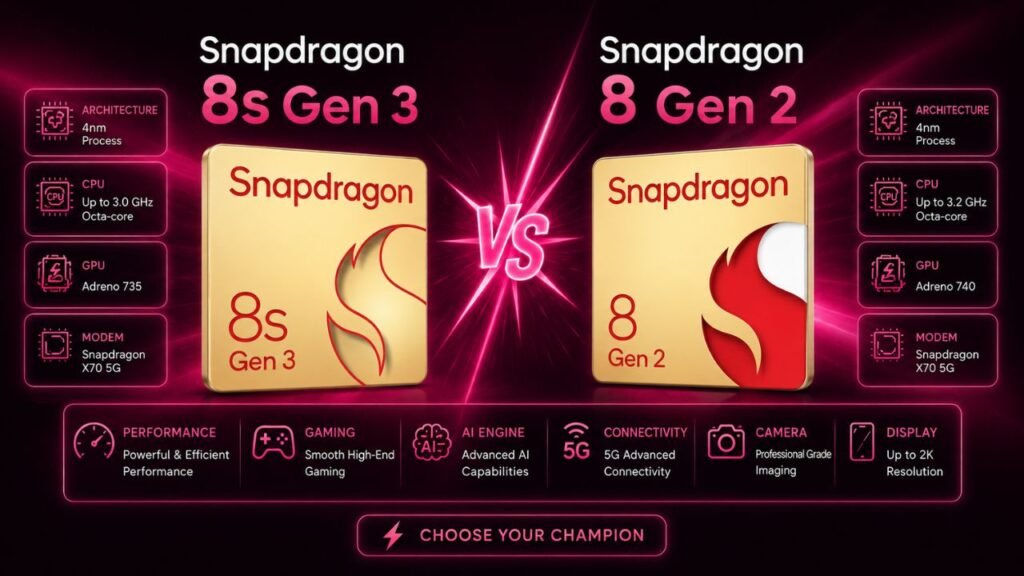
| Category | Snapdragon 8s Gen 3 | Snapdragon 8 Gen 2 |
| Launch | March 2024 | November 2022 |
| Model Number | SM8635 | SM8550-AB |
| Manufacturing Process | TSMC 4nm | TSMC 4nm |
| Prime CPU Core | Cortex-X4 @ 3.0GHz | Cortex-X3 @ 3.2GHz |
| Performance Cores | 4 × Cortex-A720 @ 2.8GHz | 2 × Cortex-A715 + 2 × Cortex-A710 @ 2.8GHz |
| Efficiency Cores | 3 × Cortex-A520 @ 2.0GHz | 3 × Cortex-A510 @ 2.0GHz |
| GPU | Adreno 735 | Adreno 740 |
| AI Engine | Qualcomm Hexagon NPU | Qualcomm Hexagon NPU |
| Gaming Features | Snapdragon Elite Gaming, Ray Tracing, Frame Motion Engine 2.0 | Snapdragon Elite Gaming, Ray Tracing, Unreal Engine 5 MetaHumans |
| RAM Support | LPDDR5X, Up to 24GB | LPDDR5X, Up to 24GB |
| RAM Frequency | 4200MHz | 4200MHz |
| Storage | UFS 4.0 | UFS 4.0 |
| Maximum Camera | 200MP | 200MP |
| Video Recording | 4K @ 60FPS, 1080p @ 240FPS | 8K @ 30FPS, 4K @ 120FPS, 720p @ 960FPS |
| Display Support | QHD+ 144Hz, 4K 60Hz | QHD+ 144Hz, 4K 60Hz |
| External Display | 8K @ 30Hz | 4K @ 60Hz |
| HDR Formats | HDR10, HDR10+, HDR Vivid | HDR10, HDR10+, HDR Vivid |
| Charging | Qualcomm Quick Charge 5 | Qualcomm Quick Charge 5 |
| 5G Modem | Snapdragon X70 | Snapdragon X70 |
| Peak Download Speed | 6.5Gbps | 10Gbps |
| Peak Upload Speed | 3.5Gbps | 3.5Gbps |
| Wi-Fi | Wi-Fi 7 | Wi-Fi 7 |
| Bluetooth | Bluetooth 5.4 | Bluetooth 5.3 |
| Navigation | NavIC Supported | NavIC Supported |
The Core Architectural Difference
Both are constructed in the 4nm technology of TSMC and have the same RAM (LPDDR5X), storage protocol (UFS 4.0), and X70 modem, thus in theory they look like brothers. Architecture and positioning are the true dividers in the 8 gen 2 vs 8s gen 3 battle. Snapdragon 8s Gen 3 features ARM newer Cortex-X4 and Cortex-A720 processors which are more efficient power-wise per clock cycle. Snapdragon 8 Gen 2 is based on the older mix of Cortex-X3/A715/A710, but is coupled with the Adreno 740 superior to the Adreno 735 in 8s Gen 3. To assemble the “8s” version, Qualcomm had to sacrifice part of the graphics muscle to make the CPU that much more efficient.
Another common confusion to take away is that Snapdragon 8s Gen 3 is not a step-up of full Snapdragon 8 Gen 3, but a step-down. Qualcomm constructed it by merging the new CPU cores of the Gen 3 with the previous Internet Adreno 740-based single-unit graphics of the 8 Gen 2 and placed it at an intermediate price between the 8 Gen 2 and the entire Gen 3.
Benchmark Comparison: Geekbench and AnTuTu
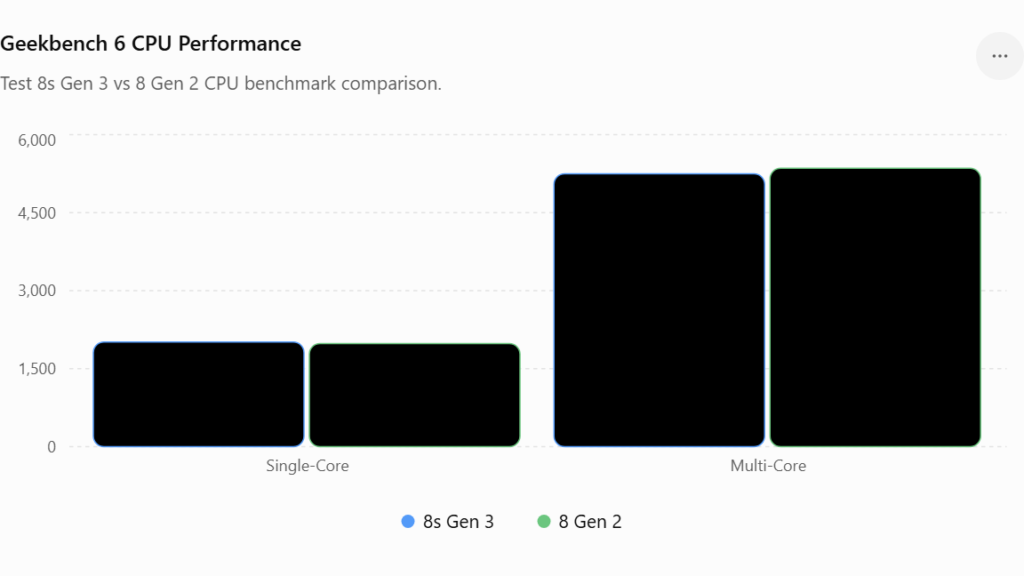
Geekbench 6: A Near-Tie on CPU
| Test | 8s Gen 3 | 8 Gen 2 |
| Single-Core | 2,013 | 1,984 |
| Multi-Core | 5,247 | 5,356 |
That is a spacing that you would never pick when you use the phone.
AnTuTu v10: The GPU Gap Shows Up
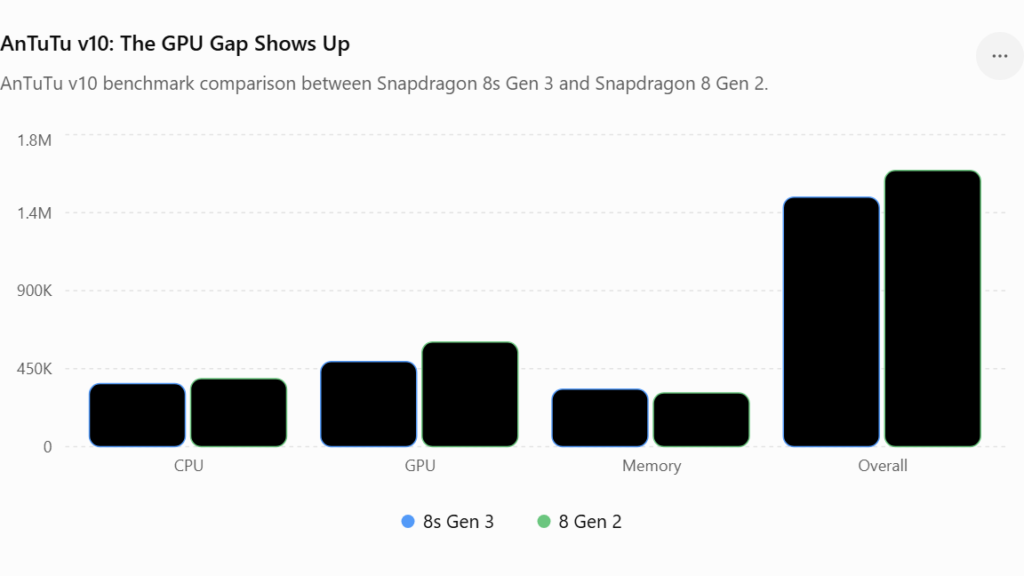
| Category | 8s Gen 3 | 8 Gen 2 |
| CPU | 363,576 | 392,389 |
| GPU | 490,838 | 603,295 |
| Memory | 331,461 | 310,704 |
| Overall | 1,439,642 | 1,593,677 |
The biggest point difference between these two chips is the GPU gap, with more than 100,000 points, and this is the larger difference that causes the overall score to lean towards the 8th Gen 2. The 8s Gen 3, with more memory handled by claws in the background, offers faster app switching but does not bridge the graphics gap.
Sustained Performance Under Load
During long stress (CPU) tests, the 8s Gen 3 maintained 94 percent of the peak performance, which was 75 percent with the 8 Gen 2. Therefore the older chip runs faster in their short bursts, whereas the new one is less throttled during extended sessions.
Gaming Performance: Where the Gap Actually Shows Up
It is the very aspect where the 8 gen 2 vs 8s gen 3 phenomenon ceases to be just on paper. The 8 Gen 2 features Adreno 740 that makes strenuous scenes, ultra settings, mobile 3D lighting, and ray tracing easier to play than the Adreno 735. The 8 Gen 2 provides less variable frame rates in gameplay such as BGMI, COD Mobile, or Genshin Impact at top settings as well as during extended gameplay.
The 8s Gen 3 is not a weak one as it can smoothly run everything with high settings, however, a competitive or multi-hour player will appreciate the few extra gigs the 8 Gen 2 has to offer, once the thermals begin to accumulate.
Camera and Video Recording
Awak, photography is a wash. The two chips share the same Spectra 18-bit Triple ISP, can support sensor up to 200 MP, and have equal performance with AI scene detection, HDR, and the night mode. The quality of the end image is much more heavily reliant on the hardware in the camera of the phone than the chipset.
Video is where 8 Gen 2 excels: 8K30fps and 4K120fps compared to 8s Gen 3 4K60fps limit. That is a difference you can really use, whether you are shooting a lot of video or slow-motion clips.
Battery Life and Efficiency
Since the cores in the 8s Gen 3 are designed to run at a lower power draw at more moderate loads, it will be slightly colder and consume less battery when used normally, such as browsing, message, and streaming. Higher power consumption of the 8 Gen 2 under load is due to its more powerful GPU, that is unlikely to be seen on a daily basis but only under heavy graphics, such as during some gameplay or intensive video editing.
Which Phones Use Each Chip
Examples of phones that feature Snapdragon 8 Gen 2 are Samsung Galaxy S23 series, OnePlus 11 and 12R, Xiaomi 13 series, Redmi K60 Pro, Honor Magic 5 series, POCO F5 Pro and Motorola Edge 40 Pro. Numerous of them fell since their release, so they are a good value choice nowadays.
Snapdragon 8s Gen 3 is used in phones such as the OnePlus Nord 5, Motorola Edge 50 Ultra, Xiaomi 14 Civi, POCO F6, Realme GT 6, iQOO Neo 10R, iQOO Z9 Turbo as well as the motorola Razr 50 Ultra foldable. They are normally found in the upper-mid-range price bracket, about 500 to 800 dollars.
Price Positioning in 2026
The 8 Gen 2 is older than the newer chip and because of that, phones with the 8 gen 2 chip are now generally cheaper because there are now newer flagships of which you can still enjoy great chip strength, but not be obliged to pay the flagship cost. Qualcomm priced Snapdragon 8s Gen 3 phones as an upper-mid-range phone at launch, however, so they usually fetch a slight premium over a similarly-age 8 Gen 2 phone, albeit with a more recent CPU.
Who Should Skip Both
Both of these are more than enough power than you will use, in case your budget is near the bottom of either of these brackets, or you only use your phone to make calls, send messages and do some light browsing. A mid-range chip such as a Snapdragon 7-series will be able to perform all of the daily tasks just as well, but at a significantly cheaper price, and the difference between 8 gen 2 and 8s gen 3 will only be significant when gaming, heavy multitasking or video processing are involved.
My Take: Which One Would I Actually Buy?
Having read the figures with my friend, and myself having used phones with both chips, here is where I came; and the reasons why.
When an individual spends most of their time gaming on their phone, capturing videotapes, or editing the information, I would refer them to a Snapdragon 8 Gen 2 device easily. The Adreno 740 is merely the more powerful GPU, and it is reflected in the situations that count: lengthy gaming periods, 8K videos, multitasking. And it is a bit more affordable at the moment, as well, being the older chip, and, therefore, a truly great value option in 2026.
However, as a daily driver, I would be drawn to Snapdragon 8s Gen 3. I use my phone primarily to chat, browse, social media and stream, and I play games occasionally. With that combination, the efficiency of the newer CPU architecture and the higher sustained performance performance is much more important to me than the additional GPU benchmark score, which I will hardly ever saturate. When I am using it under normal conditions, it is colder in my hand and I prefer it that way, as opposed to a frame rate figure which I never use.
And, my sincere advice on 8 gen 2 vs 8s gen 3 is the following: do not pursue the newness. Follow your real pattern of use. Video creators and gamers should be inclined towards the 8 Gen 2. Anyone seeking convenient, efficient daily function will likely be interested in the 8s Gen 3, everybody the rest.
Final Verdict by Category
| Category | Winner |
| CPU Efficiency | 8s Gen 3 |
| GPU / Gaming | 8 Gen 2 |
| Video Recording | 8 Gen 2 |
| Battery Efficiency | 8s Gen 3 |
| Overall Benchmark | 8 Gen 2 |
| Sustained Performance | 8s Gen 3 |
Conclusion
There is no single winner in the 8 gen 2 vs 8s gen 3 argument, this is where the idea lies. Snapdragon 8 Gen 2 is also the more gaming-friendly and proficient with both only in terms of graphics and high-quality video and is supported by the higher benchmark performance with the more competent Adreno 740 pub. Snapdragon 8s Gen 3 counters it with a more modernized and efficient CPU architecture that stands more when used massively and consumes a lot of… less battery during daily utilization.
The 8 Gen 2 remains among the most powerful flagship chip options at Qualcomm, and is often cheaper now, in case the gaming and content creation are central to your life on the phone. The 8s Gen 3 is the wiser choice should you want to have a daily performance that is smoother, more efficient and a phone that doesn’t heat as much in your pocket. In either case, the correct response to 8 gen 2 vs 8s gen 3 boils down to the usage of your phone, not the name that the chip has been given lately.
Frequently Asked Questions
Yes, marginally in single-core CPU tasks. Generally, no, the 8 Gen 2 victors in GPU and the overall benchmark results.
Snapdragon 8 Gen 2, being an upgraded version, has a more powerful (Adreno 740) GPU.
Snapdragon 8s Gen 3, as it has newer, less energy-consuming CPU cores.
Yes, particularly with gaming and video and frequently at a reduced price compared with newer chips.
No, The 8s Gen 3, as the name suggests, is a cheaper variant, which combines the CPU of the Gen 3 with an even older GPU, placing it below the complete Snapdragon 8 Gen 3.
Read About Our Mobile Comparison:
- iPhone 16e vs iPhone 13: Full Comparison & Verdict
- Vivo V70 vs V70 Elite: Full Comparison, Specs, Price & Verdict (2026)

Hi, I’m Aarav Kapoor. I have 5+ years of experience in the technology industry, specializing in smartphones, mobile prices, specifications, comparisons, and buying guides. I recently started this website to help users make informed purchasing decisions by providing accurate pricing, detailed specifications, and the latest updates on smartphone launches from trusted and official sources.